


Opening remarks from John Murphy III, CEO and President of the Association for Accessible Medicines (AAM) started the GRx+Biosims conference today, and in these remarks, he noted the importance of generics and biosimilars in lowering the cost of prescription drugs and describing the progress of the AAM in that accomplishment. We heard from John Brooks, JD, the Deputy Administrator and Director Medicare, from CMS, who participated in a fireside chat and discussed the how the CMS’ role interplayed with the goal to get generics and biosimilars better positioned in drug product selection for Federal programs.
Darby Kozak, Ph.D., Director, Office of Generic Drugs, gave an update from OGD on their activities in FY 2026. Dr: Kozak noted that, from a number standpoint, OGD approved or tentatively approved 952 ANDAs. Unfortunately, the individual breakdown of actual Approved and Tentatively approved ANDAS has not yet been published on FDA’s website. I think that likely, when considering the number of tentatively approved applications when looking at the total number of approvals from OGD makes OGD’s ANDA output look even better. But that is just my guess, as this is the second year in a row that the total number of Approved and Tentatively approved ANDAs was provided as a single figure at the GRX+Biosims meeting. I checked the OGD dashboard and the official numbers for September are not yet posted (I will have them for you once OGD updates the dashboard).
Dr. Kozak did provide a chart showing the decline in new ANDA submission trends over the past few years and also showed a robust submission of supplemental applications and controlled correspondences. Something that was quite notable was the number of complex ANDA submitted to OGD. Note the chart indicated that OGD received 638 ANDA in FY 2026, which (if true) means that OGD received 116 ANDAs in September alone!
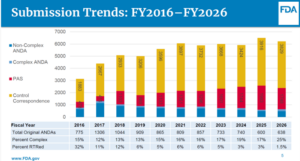
Of the 952 approvals, 107 were for first time generics, 139 were for drugs designated as Competitive Generic Therapy (GCT) products, and 121 were for products classified as complex generics.
The number of generic drug products that were 60 days past their goal date has been dropping steadily quarter after quarter since Q2 in FY 2025. He spoke of the other science and research initiatives including the fact that OGD had 91 presentations, 44 posters, and 54 scientific articles published. In addition, he noted that OGD presented 10 public workshops with over 17,000 attendees, issued 480 new and revised product specific guidances and outlined 8 new scientific initiatives it was pursuing.
As far as reduction in regulatory requirements in OGD, 17 PSGs for peptide products were revised to allow the use of non-clinical methods which can support a proposed generic peptide (recombinantly, synthetically, or semi-synthetically produced) compared to its RLD and using the outlined in vitro and characterization revisions will conclude they can be expected to have the same clinical effect and safety profile as the RLD.
He cited important first time approvals for complete products including conjugated estrogens (Premarin), beclomethasone dipropionate MDI (Qvar), and Dapagliflozin (Farxiga), to name a few.
He also discussed OGD’s success in preventing new drug shortages with only 4 occurring in 2025. In addition, he discussed the passage of the Q1/Q2 legislation which “grants FDA new authority to share more information with generic drug applicants on how a proposed generic formulation may not be qualitatively (Q1) or quantitatively (Q2) same to the proposed RLD for those products required by rule to be Q1 and Q2 the same”.
It was quite a year for OGD, and it looks like it ended the year on a high note. We will have more for you on the conference tomorrow.