


Today the FDA published 15 new and 14 revised Product Specific Guidances (PSGs) (here). The draft guidances provide product-specific recommendations on, among other things, the design of bioequivalence (BE) studies to support abbreviated new drug applications (ANDAs).
Once draft recommendations are issued, the FDA accepts comments to the proposed PSGs prior to their finalization. However, before finalization or even after a guidance becomes final, based on new information that becomes available to the FDA, some of the initial recommendations for study design may change and FDA may revise the guidances.
In some instances, the FDA has changed its once favored approach for establishing the bioequivalence of a test and reference product to less burdensome methods, for instance removing a fed study requirement or permitting a full in vitro approach versus an in vivo approach.
At the GRx+ Biosims meeting, I had learned that OGD was planning to provide information to identify the changes made in a PSG when the document was revised. Well, this set of PSGs for the revised guidances do have such change descriptions documented. For instance, in the revised draft guidance for Carbinoxamine Maleate tablets of various strengths the FDA has included a revision history at the end of the PSG (see below).
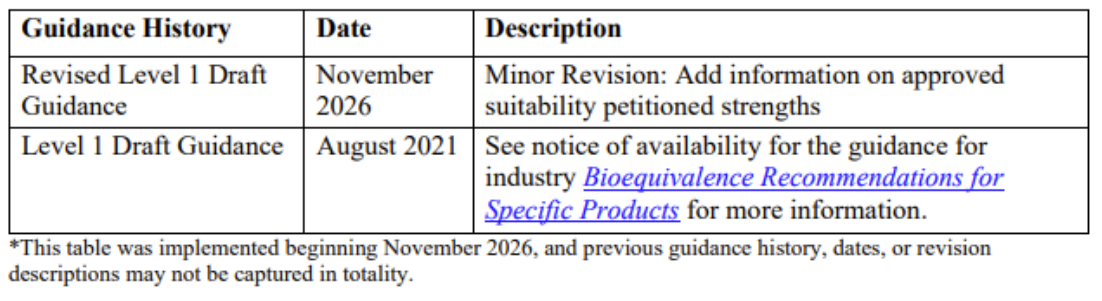
Note the asterisk statement beneath the boxed revision history at the end of the PSG. It says the revision history will apply beginning in November 2026, so older revised guidances will not be updated. I have called for this change in numerous blog posts, because describing what changed in a revised guidance would make life easier for industry, just as FDA expects firms to document changes through version control when an SOP is revised. An FDA official I spoke to at the AAM meeting said this would be coming soon and now here it is for the first time. So, a big thanks to the Agency for implementing the revision history change!