

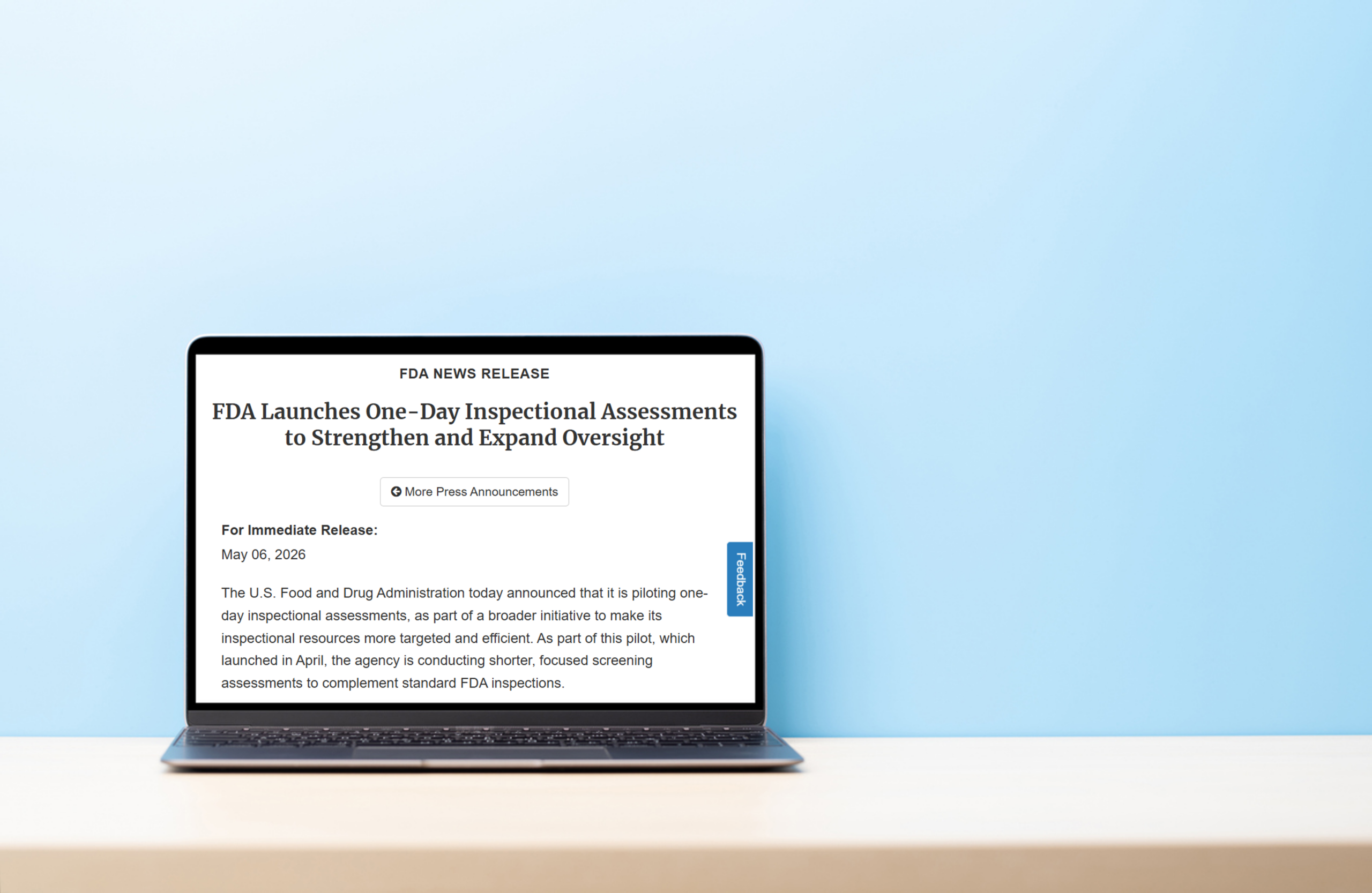
What began as a concept previewed earlier this year has now become official policy. Today, the U.S. Food and Drug Administration (FDA) announced the launch of its “One-Day Inspectional Assessments” program, formalizing a new inspection model aimed at certain low-risk facilities (here). Under the initiative, qualifying sites may undergo a streamlined, single-day inspectional assessment while investigators retain full authority to expand the inspection if concerns emerge.
The announcement is significant, not simply because inspections may become shorter, but because it signals a broader evolution in how FDA intends to allocate oversight resources moving forward.
Notably, FDA Commissioner Marty Makary stated, after this morning’s fireside chat at the annual FDLI conference, that the Agency had already piloted the approach at both domestic and foreign facilities, and noted that the effort had gone “very well.” The official rollout suggests that FDA believes the model is operationally viable and scalable across broader segments of industry.
At its core, the initiative reflects a more mature form of risk-based regulation. FDA has long emphasized that not every facility presents the same level of risk, but this program creates a more visible distinction between facilities that consistently demonstrate control and those that warrant deeper scrutiny. In practical terms, the Agency appears to be moving toward an oversight structure where inspection intensity is increasingly calibrated to operational performance, compliance history, product risk, and broader data signals available to the Agency.
A critical piece of the model is increased use of remote review activities before investigators arrive onsite. FDA has already expanded its use of remote regulatory assessments and other offsite review mechanisms in recent years, allowing investigators to evaluate documentation, data, and records ahead of time. Rather than spending multiple days reviewing large volumes of documentation onsite, investigators can arrive with an understanding of the facility, systems, and potential risks already in hand. The onsite portion then becomes more focused on verification: confirming that systems operate as described, assessing management oversight, evaluating data integrity, and determining whether the organization demonstrates real operational control under questioning.
In many ways, an inspection becomes less exploratory and more confirmatory—unless something does not align. If investigators identify inconsistencies, weak controls, unreliable data, unresolved quality signals, or other potential safety issues, the inspection can immediately expand beyond the one-day format.
This dynamic changes the inspection environment for industry.
For organizations with mature quality systems, the advantages are obvious: reduced operational disruption, fewer inspection days, and a more predictable regulatory interaction. Facilities that maintain strong inspection readiness at all times may benefit from a more efficient oversight process that rewards operational consistency.
For organizations operating with weaker systems or unresolved quality issues; however, the model may feel substantially less forgiving. A compressed inspection format leaves little room to shape the narrative gradually over several days. Early signals become disproportionately important. The ability to quickly produce accurate records, explain decisions clearly, and demonstrate command of quality systems in real time becomes central to the outcome.
The initiative also aligns with several broader trends already reshaping FDA oversight. The Agency has steadily increased its reliance on risk-based inspection planning, remote assessments, advanced analytics, and more targeted inspection strategies. At the same time, international regulators, such as the European Medicines Agency (EMA) and the Medicines and Healthcare products Regulatory Agency (MHRA) have been pursuing similar approaches, focused on efficiency, risk prioritization, and data-driven oversight.
If FDA successfully demonstrates that streamlined inspections can be effective across both domestic and international operations, the model could influence broader global inspection practices over time.
As regulatory oversight becomes increasingly risk-tiered, consistently being viewed as a “low-risk” facility may evolve into a competitive differentiator. Sponsors, supply-chain partners, and investors are highly sensitive to regulatory disruption. Facilities capable of moving through FDA inspections efficiently and without escalation may become more attractive as manufacturing and development partners.
In that sense, inspection performance begins to influence not only compliance outcomes, but business strategy.
For Lachman, this development reinforces an important shift already occurring across industry. Companies are no longer focused solely on whether they can survive an inspection. Increasingly, the question is whether they can demonstrate control immediately, efficiently, and convincingly from the outset, and this requires a different level of operational readiness.
Organizations will need systems that are continuously inspection-ready, documentation that can withstand both remote and onsite scrutiny, and personnel capable of responding clearly and confidently under compressed timelines. Inspection preparedness becomes less about assembling information during the inspection and more about maintaining a constant state of operational transparency and control.
Stepping back, the broader message from FDA is clear. The Agency is not signaling reduced oversight. If anything, it is signaling more precise oversight—leveraging remote review, risk analytics, and targeted onsite assessments to focus attention where the Agency believes it matters most.
For companies with robust, well-functioning quality systems, this may ultimately reduce regulatory burden. For others, it raises risk.
Either way, the direction is clear: inspections are becoming faster, more targeted, more data-driven, and more dependent on early indicators of control. In this environment, success is no longer defined simply by getting through an inspection, it is defined by how efficiently and how credibly you can demonstrate that your systems work from the very beginning.
If you would like information on how Lachman Consultants can help your firm achieve this level of operational readiness, please reach out to us at LCS@lachmanconsultants.com for a consultation.